
RapidCheck: The Greatest Accuracy with the Fastest Turnaround
Dental unit waterlines (DUWLs) are essential for patient care but highly susceptible to biofilm formation. Biofilms can continually release bacteria into water used during procedures, posing infection risks. The CDC has established that water used in nonsurgical dental procedures meet ≤500 CFU/mL.
For years, practices have trusted StandardCheck™ (R2A) testing, which takes 5 days to deliver results. While StandardCheck™ is a well-established and reliable method, the time to results can lead to extended downtime or delayed corrective action. RapidCheck™ using flow cytometry has emerged as a fast, highly accurate alternative for monitoring microbial load in dental waterlines—providing actionable results in hours instead of days.
RapidCheck™ – The Newest Frontier of Waterline Testing
RapidCheck™ uses fluorescent dyes and laser‑based detection to count and differentiate cells in dental water samples. Unlike StandardCheck™, which detects only culturable bacteria, RapidCheck™ measures all bacterial cells—including those in a viable‑but‑non‑culturable (VBNC) state. This is significant as culturable bacteria – microorganisms capable of being grown and isolated in a lab setting – only represent approximately 1% of total bacterial diversity. As a result, traditional culture-based test methods (which includes most in-office tests too) may fail to capture harmful species such as legionella, mycobacterium, parasites, and viruses. Although these VBNC cells cannot be grown on a culture plate, they may still pose infection risks. By detecting them, RapidCheck™ gives dental practices a more complete microbial picture and helps prevent compliance failures before they arise.
Explaining Flow Cytometry
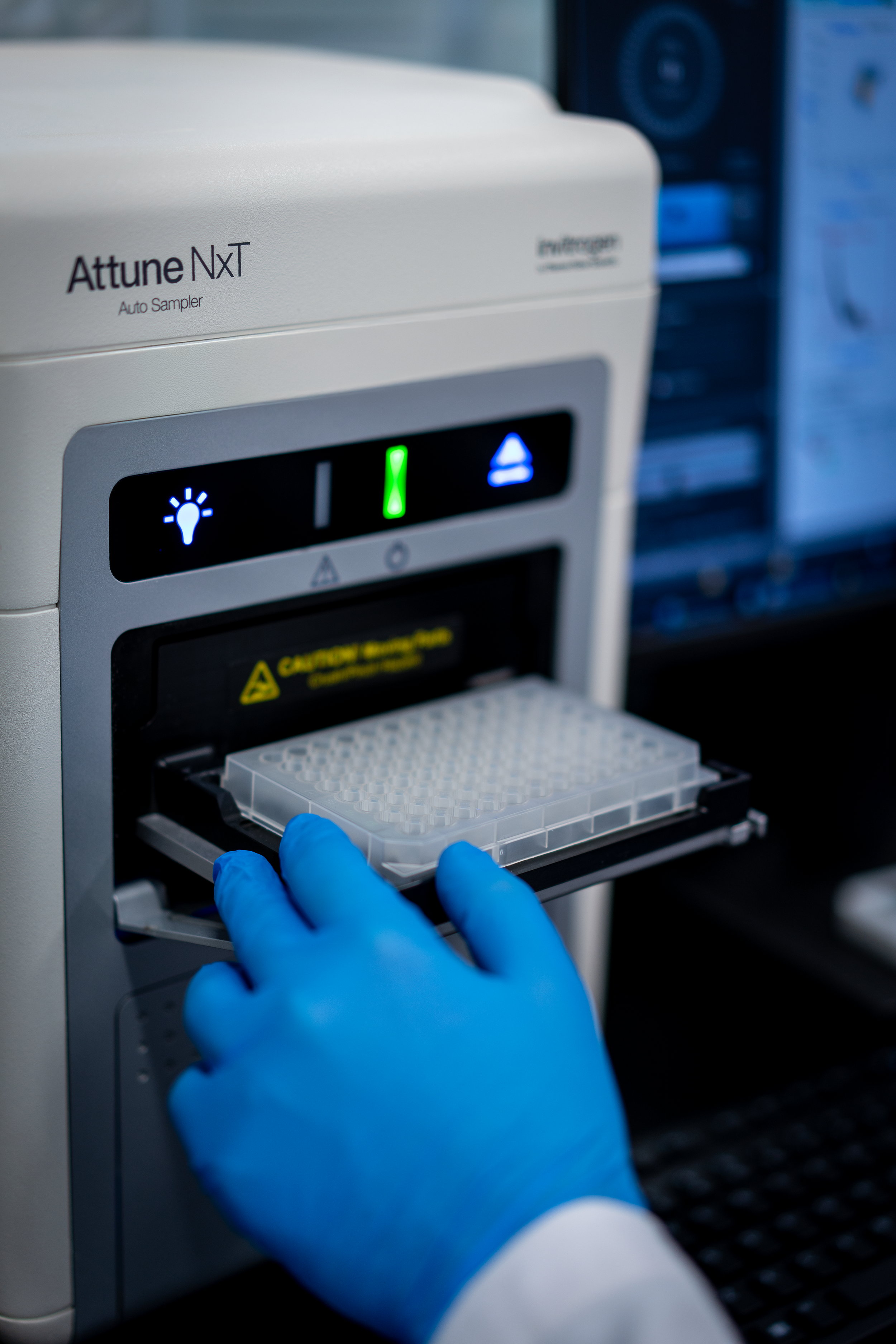
Flow cytometry is a laser‑based analytical technology designed for rapid, high‑precision analysis of cells suspended in a fluid. In dental waterline testing, it allows for direct counting and characterization of bacteria without the need for incubation. This means Agenics can provide waterline test results on the very same day that samples are received.
The process begins with staining the waterline sample using specialized nucleic‑acid dyes that bind to cellular material. The instrument’s fluidics system then transports the sample and focuses the cells into a single‑file stream. As each cell passes through a focused laser beam, the dyes fluoresce, producing both scattered and emitted light. The optics system collects this light, and the electronics convert the signals into digital data for analysis.
Flow Cytometry for Dental Water
The Application of Flow Cytometry to Dental Water
With RapidCheck™, water samples are stained with two nucleic‑acid dyes. As each cell passes through the laser, detectors measure:
Forward scatter (FSC) – related to cell size
Side scatter (SSC) – related to structural complexity
Fluorescence intensity – used to differentiate live from dead cells
This measuring process allows RapidCheck™ to quantify total and live bacterial cells with high sensitivity—detecting concentrations as low as 100 cells/mL
The data is visualized as a density plot, where live and dead bacteria appear in distinct regions according to their fluorescence signatures. Advanced gating strategies—performed by our trained lab analysts—ensure accurate identification of live bacteria even in challenging or variable samples. This approach captures microbial populations that traditional culture methods routinely miss.
The Benefits of Flow Cytometry for Dental Practices
Traditional heterotrophic plate count (HPC) methods such as R2A agar plating require 5 days of incubation and detect only culturable bacteria. Research shows that up to 99% of bacteria in water may be viable but not culturable, meaning they go undetected with HPC-based testing.
Flow cytometry overcomes this limitation by measuring both culturable and VBNC cells, providing:
faster results
greater sensitivity
a truer representation of total microbial load
This is particularly important for infection control because VBNC cells—including known waterborne pathogens—can remain metabolically active and potentially harmful. And while RapidCheck does not report dead cells, the method allows Agenics water specialists to assess the bacterial load that the treatment products are having to control. A large quantity of dead cells may indicate that the source water being used has high levels of living bacteria going into the treatment product, increasing risk of product failure.
Relationship to Traditional Methods
Correlation and Reliability: RapidCheck™ vs. StandardCheck™
To ensure accuracy and clinical relevance, RapidCheck™ (flow cytometry) was rigorously correlated to StandardCheck™ (R2A plating) using thousands of real‑world dental waterline samples. Pass/fail thresholds for RapidCheck™ were established based on this correlation, ensuring that results align with regulatory expectations and provide clear, actionable guidance.
Continuous data collection, quality‑control procedures, and method validation reinforce the reliability of RapidCheck™, making it a trusted tool for dental practices seeking rapid, compliance‑ready waterline testing.
Understanding StandardCheck™ (R2A)
StandardCheck™ has historically been the industry standard for compliance testing. It measures heterotrophic plate counts (HPC) by culturing bacteria on R2A agar for 5 days. While accurate for documentation, it only detects organisms that grow under lab conditions, missing VBNC (viable-but-non-culturable) cells that may still pose risks. Despite its limitations, StandardCheck™ remains a reliable compliance tool.
Key Benefits of RapidCheck™ for Dental Practices
Speed: Same-day results for faster remediation and reduced chair downtime.
Sensitivity: Detects VBNC organisms missed by traditional culture methods.
Trend Monitoring: Helps identify early signs of regrowth or biofilm release.
More Insights: While not reported, RapidCheck identifies dead cells as well, providing an indication of the bacterial load of the source water being used, which may help identify failure root causes.
Improved Patient Safety: Rapid detection supports infection control protocols.
Operational Efficiency: Same-day results enable timely corrective actions, reducing chair downtime and increasing productivity.
Data-Driven Decisions: Provides actionable insights for preventive maintenance.
Application
Implementation Strategies for Dental Practices
Routine Monitoring: Begin by testing monthly using StandardCheck™ or RapidCheck™. Once two consecutive months of passings results are obtained, continue testing monthly or adjust to a quarterly cadence for ongoing compliance.
Action Response: If failures occur, shock the waterlines and use RapidCheck™ for quick turnaround when retesting samples to avoid longer downtime.
Documentation: Agenics maintains all reports on our online portal. Integrated water analytics (pH, TDS) is included with all testing to help understand root causes of failures and adjust treatment protocols accordingly.
Compliance and Accreditation
Meeting CDC and state dental board requirements is critical for patient safety and practice reputation. StandardCheck™ provides the official CFU/mL counts required for compliance, while RapidCheck™ offers the added benefit of rapid screening for retesting. Combining both methods ensures robust infection control and audit readiness.
Frequently Asked Questions
-
RapidCheck™ (flow cytometry) has been directly correlated to StandardCheck™ using thousands of real-world dental samples, making it a reliable testing method with a quick turnaround time.
-
Yes, RapidCheck™ delivers same-day results so you can shock and retest quickly, reducing extended shutdowns.
-
That is up to you. RapidCheck™ complements StandardCheck™ by providing rapid screening and trend monitoring while StandardCheck™ provides photo documentation of cultured samples using an EPA Standard Method.
-
Use a risk-based analysis to set your own action limits, or alternatively, use the action limits provided in Agenics test reports. A pass has <200 CFU/mL and requires no action; a caution is >200-499 CFU/mL and should be shocked to get the bacteria levels to the passing range. A reading of >500 CFU/mL is considered a failure, and remedial action should be performed, such as shocking followed by a retest.
-
All testing materials are included in our kits. Agenics Labs handles testing, so you simply collect and ship samples the same day.
Actionable Steps for Dental Teams
Review your current water testing schedule and identify gaps.
Add RapidCheck™ for retesting or post-shock verification.
Determine if your team prefers RapidCheck or StandardCheck™ for routine monitoring.
Train staff on sampling best practices.
Document all results and corrective actions for audits.
How Agenics Labs Supports You
Agenics Labs offers RapidCheck™ for the fastest lab testing available and StandardCheck™ for trusted familiarity and thorough documentation. Agenics also provides Sampling Best Practices and Shock Protocol Guides to keep your waterlines safe. Explore our Dental Water Testing Hub for products and resources: Link
-
Buysschaert, B., Vermijs, L., Naka, A., Boon, N., & De Gusseme, B. (n.d.). Online flow cytometric monitoring of microbial water quality in a full-scale water treatment plant. https://www.nature.com/articles/s41545-018-0017-7.pdf
Carey, C. M., Mills, S. E., Vigil, R., Aungst, M., & Favazzo, L. (n.d.). Application of flow cytometry to analyze microbial quality of dental unit water. ADA. https://jadafs.ada.org/article/S2772-414X%2824%2900007-0/fulltext
Distribution System Water Quality. EPA. (n.d.-a). https://www.epa.gov/system/files/documents/2023-08/DS%20Toolbox%20Fact%20Sheets_HPC_508ed.pdf